
It would seem that one of the undeniable patterns in the history of technology development is that new generations adopt technological changes at a faster pace.

In his new book Day Trade Attention, influential digital opinion leader Gary Vaynerchuk has an entire section to talk about X (formerly Twitter), and throughout the entire section Gary refers to "X" as "Twitter," which also tells us that regardless of how immersed you are in the digital ecosystem and new technologies, all people are susceptible to being resistant to change and slowing down the adoption curve.
And scientific communication is no exception, which represents a paradox: often those with the most experience are the most reluctant to change their way of doing things.
How long does it take us to reach 25% adoption of new technologies?
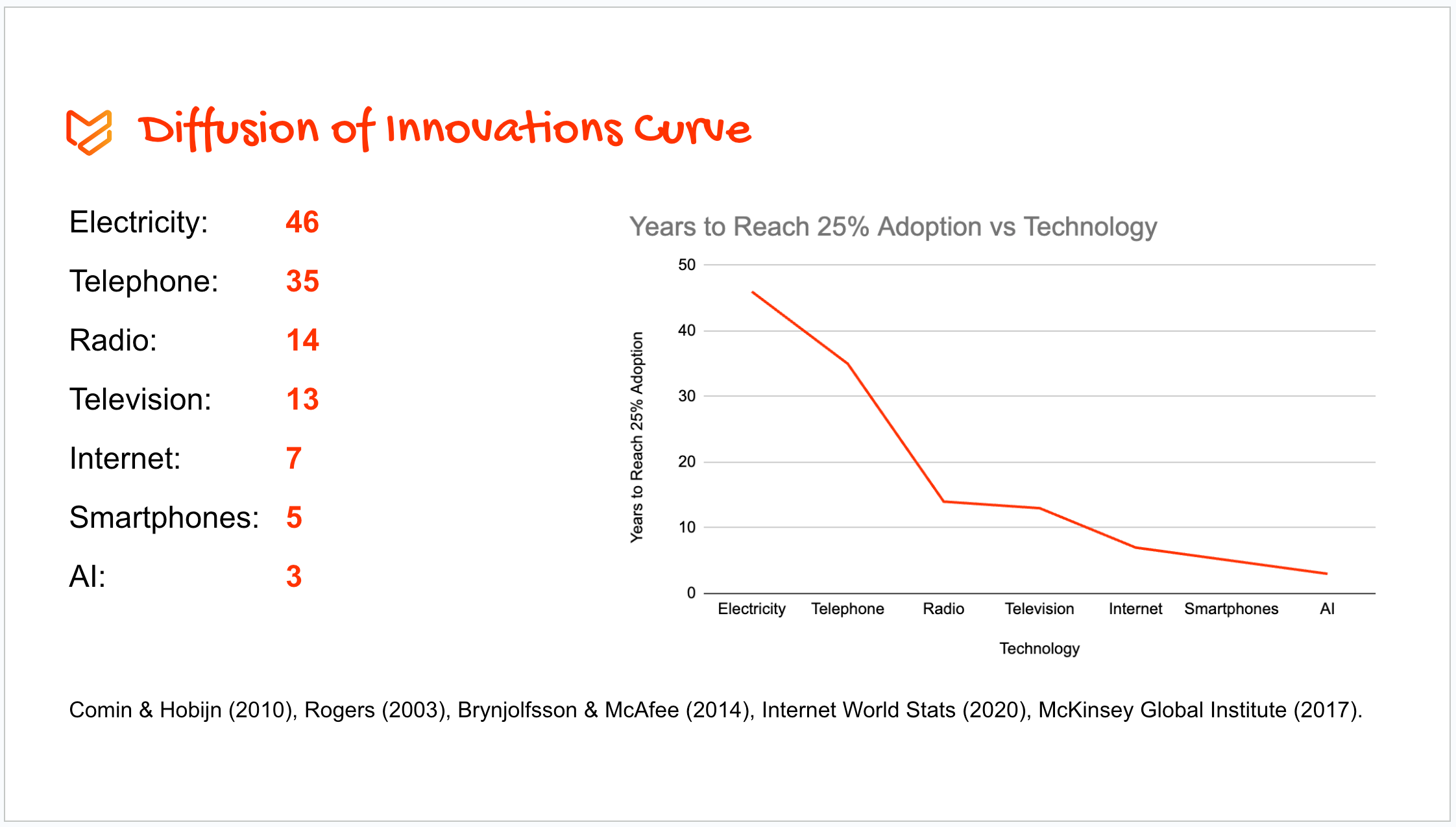
Paradoxically, even though individuals within the scientific community may take time to adopt new technologies, as a society we are taking less and less time. According to this technology adoption curve, we have gone from taking 46 years to only 3, from the adoption of electricity to artificial intelligence, in just half a century.
If this curve maintains its trend, whatever the next disruptive communication technology is could take perhaps a year, or less than a year for a significant proportion of society to adopt it.
From the perspective of medical communication
One of the implications of this pattern is that people are adopting these technologies increasingly faster, while the most recognized doctors continue to take their own time to incorporate them.
That's why at Leaderlix we met with IAB México, the most relevant Mexican association promoting and disseminating digital technologies. In this edition of our newsletter we present some of the most interesting insights from this conversation.

Learning to communicate science with emotion without losing credibility is a key direction that all those responsible for health marketing must take very seriously. If you're looking for how to do it effectively, you can download for free our eBook: Rockstars of Storytelling. Download it for free here.
Scientific communication has experienced significant transformations over the past decade, driven by digitalization and the need for reliable information. Claudia Ponce, Education Manager at IAB México, shares her vision on current trends and the challenges the industry faces in training and developing key stakeholders, from doctors to digital marketing leaders.
About Claudia
I've always had an inclination to understand how things work, and that led me first to explore areas like communication and data analysis.
My interest in connecting ideas with audiences and transforming complex messages into something accessible to everyone drove me to explore new tools and channels.
As digital marketing began to expand, I saw a perfect opportunity to apply those skills in a field where creativity and strategy come together to generate measurable results.
My journey in digital marketing really began when I realized that I could combine my passion for technology, effective communication, and behavior analysis to design strategies that not only captured people's attention, but also connected them with valuable solutions.
From there, I began to delve deeper into how to optimize campaigns, work with data, and use digital storytelling to create meaningful brand experiences.
It was a natural process that led me to specialize and build a career in this area, always maintaining as a foundation my interest in the real impact that communication can have.
Trend 1: Integration of Digital Technologies in Scientific Communication
Technological advancement has radically changed the way scientific information is communicated. According to Claudia, the pandemic was a catalyst that accelerated the adoption of digital technologies in the pharmaceutical and health industries. This transformation has led to a full integration of digital communication strategies. What was once limited to search engines and emerging social networks has now expanded to omnichannel platforms that combine social networks, artificial intelligence, and big data.
One of the most impacted areas has been the dissemination of medical information. The need to ensure that this information is accurate, ethical, and evidence-based has driven companies to invest in more rigorous compliance and regulatory processes.
"The responsibility to guarantee the veracity of medical information is increasingly greater in a digital environment where the reach and speed of communication are exponential," Claudia notes.
Trend 2: The Rise of Doctor Influencers and the Generational Gap
A growing trend is the emergence of doctor influencers who use platforms like TikTok and YouTube to reach patients directly. This new generation of communicators has found in social networks an effective way to share scientific information, often overcoming traditional barriers to access to studies and specialized resources.
However, this phenomenon has also exposed a considerable generational gap between those health professionals who have adopted these technologies and those who have not. Claudia highlights that this gap can be closed through training in digital skills, not only to improve communication between doctor and patient, but also to remain competitive in a market where digitalization is key.
"It is essential that health professionals receive training in digital tools to make the most of new technologies and better connect with their audiences," Claudia affirms.
The key is to foster a continuous learning environment where doctors can integrate these tools into their daily practice, thus reducing the distance between generations and adopting new formats of communication.
Trend 3: Toward Omnichannel Communication and the Adoption of Artificial Intelligence
The future of medical communication is moving toward the integration of technologies such as artificial intelligence, big data, and automation tools. In this context, platforms like ChatGPT and traditional search engines are converging to offer more precise and personalized responses to medical queries.
Claudia mentions a recent experiment where a doctor compared the information provided by ChatGPT with clinical studies and found that accuracy was notable.
Despite these advances, the adoption of these technologies requires that both companies and health professionals adapt to an environment of constant innovation.
Claudia emphasizes that training and the development of digital competencies are crucial to keeping up to date in a sector where technology plays a fundamental role. "The integration of artificial intelligence not only improves campaign efficiency, but also transforms the way information is delivered to patients, making it more accessible and relevant," she adds.
How to close the gap?
Claudia Ponce emphasizes that the key to closing the generational gap in scientific communication lies in continuous training and the adoption of good digital practices.
Health professionals must receive training not only in the latest technological trends, but also in how to apply these tools in an ethical and effective manner. This includes everything from proper use of social networks to the integration of digital strategies in their daily communication.
"The generational gap should not be an obstacle; rather, it is an opportunity for professionals of all ages to benefit from new technologies and find more effective ways to connect with their patients," Claudia concludes.
Claudia commented: "At IAB México we recently launched a report that offers an updated vision on the evolution of communication in the health industry. We address how digital integration is moving toward omnichannel communication, the role of digital opinion leaders, and new regulations in health advertising. It's a key resource for understanding post-pandemic trends and is available on our website."
Additionally, she announced: "We are very excited about the diploma in digital pharma marketing. It is designed for health professionals, laboratories, and marketing specialists. It will be four months where all the content is focused on applying digital strategies to the pharmaceutical industry. We have completed 2 generations with the support of Central Media and we look forward to welcoming you for the third generation that will be held later this year!"
If you need help exploring these ideas with your team of communicators, we invite you to schedule an exploratory call and discuss your projects. We'd be happy to talk with you and evaluate together if we're a good fit.